

The transformative power of nature: A new business member profile
Research has long shown that time spent in nature is good for us, body and soul. The American Heart Association, among...


From the single-use water bottles, containers and bags you might carry into the park to microplastics detected in the lake water around the islands, plastics are having an impact on the Apostle Islands National Lakeshore. Doing something about our personal and global dependence on plastics is the global theme of Earth Day 2024.
Earth Day is an annual event designed to promote the importance of environmental conservation and sustainability. Wisconsin Senator Gaylord Nelson founded Earth Day on April 22nd, 1970. On that day, an estimated 20 million people nationwide attended the inaugural events at tens of thousands of school and community sites across the United States. Nelson was also the key driver in the creation of the Apostle Islands National Lakeshore, established in September of that year. Since then, Earth Day has become a global movement encouraging us to take action for a healthier planet.

This year’s Earth Day theme is Planet vs. Plastics. Organizers say, “For Earth Day 2024 on April 22nd, EARTHDAY.ORG is unwavering in our commitment to end plastics for the sake of human and planetary health, demanding a 60% reduction in the production of ALL plastics by 2040.”
“The Planet vs. Plastics campaign is a call to arms, a demand that we act now to end the scourge of plastics and safeguard the health of every living being upon our planet.”
Reducing microplastics – tiny bits of plastic fibers, beads, fragments and films is one key goal of the campaign.

Microplastics have been found in the sand, water and fish around the Apostle Islands
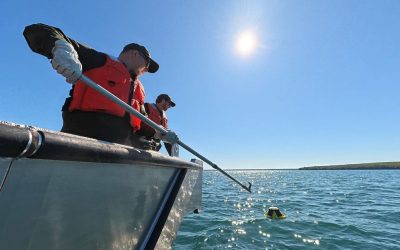
Microplastics in Lake Superior have been studied for more than a decade. A 2014 study by the University of Waterloo Water Institute in Ontario, Canada found microplastics across the entire lake. Another 2017 study study funded by the NOAA Marine Debris Program and led by the National Park Service and Clemson University found high levels of microfiber plastic pollution on Apostle Island beaches.
Microplastics were also one of the potential water quality threats discussed during the 50th Annversary Apostle Islands Resource Stewardship Symposium in 2021. Researchers have found microplastics in Apostle Islands beach sand, in the water and in the fish. You can watch that presentation here. The impact these plastics are having on the health of the fish and on the people who eat it is the subject of further study.
The University of Wisconsin Sea Grant College Program is funding research into microplastics and contaminants by the Great Lakes Indian Fish and Wildlife Commission from 2024 to 2026.
About Microplastics: Microplastic fibers often come from synthetic, plastic-based clothing like fleece jackets and athletic wear when washed. Small fibers break off and are carried through water treatment plants into our lakes and rivers. Choosing natural fiber clothing is one proactive thing you can do. How to shop sustainably for clothes.
About single-use water bottles: Americans buy 50 billion water bottles per year, averaging about 13 bottles per month for every person in the U.S. That means by using a reusable water bottle, you could save an average of 156 plastic bottles annually. Instead of single-use water bottles, consider a reusable, washable container like our new Friends Hydro Flask water bottle.
About single-use plastic bags and other containers: Consider reusable paper or natural fiber bags, like our new Starry Skies tote. Consider washable, reusable containers.
Get involved in a community clean-up: If you find plastics in the park, pack it out. Friends plans to do a clean-up event in Bayfield later this year.

For its part, the National Park Service says Secretary of the Interior Deb Haaland has issued an order calling for a department-wide approach to reducing plastic pollution. In response, the NPS has developed a Plastics Elimination and Reduction Plan that includes actions for concessioners, commercial use authorization (CUA) holders, and partners of the NPS. The Park Service also continues to work on its Green Parks Plan.
To learn more about Earth Day 2024 and the research driving the goals, visit the Earth Day website.
Share this article…
Research has long shown that time spent in nature is good for us, body and soul. The American Heart Association, among...

Bands of elk are not the only ones to gather in Estes Park, Colorado this autumn. The gateway city to Rocky Mountains...
We saw it in the first hints of crimson and gold in the mainland treeline. We felt it when the water temperature...