
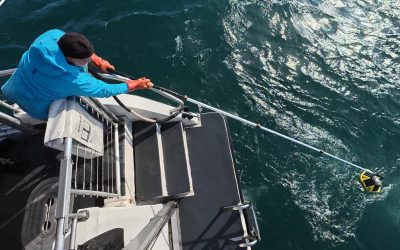
Friends receives National Park Foundation Innovation Grant as 2026 boating season ends with retrieval of final Wave Watch buoy
Days after gale warnings and the Devils Island buoy measured waves approaching 9 feet in height, the 2026 Wave Watch...


When you visit the Apostle Islands National Lakeshore and Friends board member Neil Howk is your guide, you’re in for a treat. As a retired park ranger specializing in telling the stories of the islands, Neil has a special way of immersing park visitors in the rich history and natural beauty in the park. This summer, Neil volunteered at the Raspberry Island light and took time to take stock of the many berry populations on the island, as well as what’s changed since the days of lighthouse keeper Francis Jacker in the late 1800s.
The Ojibwe name Miskominikaani-minis refers to the “island of raspberries.” We now call this place Raspberry Island. While it is true that wild raspberries grow there, anyone who walks the beach, hikes the trails, or visits the lighthouse during the summer will quickly notice that raspberries are not the only berries found on the island. Lighthouse keepers regularly gathered the wild fruit that grows on the island. Keeper Francis Jacker frequently mentioned berries in his diary.
June 27, 1886: Cold NE wind. Picked a mess of strawberries yesterday and today.
July 22, 1886: Picked up my first mess of raspberries this evening.
June 23, 1889: The indications are that there will be more raspberries and less strawberries than last year. Cranberries not yet in blossom.
September 6, 1890: J. Boutin left for home tonight. He picked about 8 bushels of cranberries; there are still about 5 bushels left.

A variety of berries can be found around the lighthouse grounds.
The mountain ash trees in front of the lighthouse are covered with reddish-orange berries in late summer and fall.
Wild raspberries grow along the steps leading from the dock to the top of the bluff and on the bluff behind the boathouse.
Cherry trees grow near the historic keepers’ outhouse.

Mountain ash
Highbush cranberry shrubs grow on the grounds and along the west edge of the lighthouse clearing.
The 0.75-mile trail from the lighthouse to the beach features a number of different berry yielding plants.
The vegetation along the trail at the transition from the clearing to the forest includes several blackberry plants.

Blackberries
Areas along the trail feature large colonies of blue-bead lily (also called yellow Clintonia). The flower stalks contain clusters of three to eight yellow flowers in the spring. As summer progresses, the berries of blue-bead lily transition from green to white, and ultimately to a deep porcelain blue. The berries should not be mistaken for blueberries. Although they are not poisonous, they are quite foul tasting and should be avoided.

Blue bead lily berries
Thimbleberry plants are found in several locations in the cool, shady forest. The plant has large, five-lobed, hairy leaves and no thorns. It bears edible red fruit that resembles a raspberry.
Canada yew is an evergreen understory shrub that dominates many stretches along the trail. Once common in northern Wisconsin forests, the species is in decline due to predation from white-tailed deer. The shrub bears red, cup-shaped, berry-like cones that are open at the top exposing a single seed.

Thimbleberries

Canada yew
The Raspberry Island sandspit harbors another set of berry plants. The stabilized dunes above the active beach contain several small pin cherry trees. Sand cherry is a small, branched shrub that produces the largest fruit of any wild cherry. Some light keepers made wine from this native fruit. A few lowbush blueberry plants can also be found here. Though the sandspit’s central bog is slowly filling in, it still produces a few of the cranberries mentioned by Francis Jacker in his diary.

Pin cherries

Lowbush blueberries

Sand cherries

An American redstart in a highbush cranberry shrub
And, oh yes, a few wild raspberries can also be found along the trail near the sandspit. This is Raspberry Island, after all.

Raspberry Island raspberries
You can learn more about Francis Jacker as part of the History Mystery series on our website. In our next installment about volunteering on Raspberry Island, Neil goes birding. You might be surprised by the number of bird species he found.
Neil Howk began working as a park ranger/interpreter for the National Park Service in 1978. He worked at a number of different parks over the years and served as the assistant chief of interpretation at Apostle Islands National Lakeshore from 1993-2016. He now serves as a board member of Friends of the Apostle Islands National Lakeshore.

Share this article…
Days after gale warnings and the Devils Island buoy measured waves approaching 9 feet in height, the 2026 Wave Watch...

Research has long shown that time spent in nature is good for us, body and soul. The American Heart Association, among...
Bands of elk are not the only ones to gather in Estes Park, Colorado this autumn. The gateway city to Rocky Mountains...