
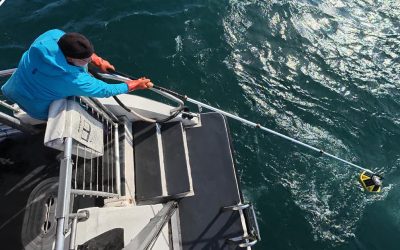
Friends receives National Park Foundation Innovation Grant as 2026 boating season ends with retrieval of final Wave Watch buoy
Days after gale warnings and the Devils Island buoy measured waves approaching 9 feet in height, the 2026 Wave Watch...


Lake Superior is making ice at a faster pace this winter than last. For the first time in several years, it’s thick enough to force the Madeline Island Ferry Line to shut down service for the season. However, it’s nowhere near normal levels and nowhere near enough ice to even think about the mainland ice caves.
NOAA’s Great Lakes Environmental Research Laboratory says 17.5% of Lake Superior is ice covered as of February 12th. As represented by the black and dark blue areas on the map below, ice hugs the south shore, covers some of the water between the interior Apostle Islands and fills Chequamegon Bay. Strong winds can break up the ice in all but the most-sheltered areas.

NOAA ice coverage map shows ice along Lake Superior shorelines. Light blue represents open water in the middle
As the chart below demonstrates, ice production so far this winter (the dark blue line) is far below average, which is represented by the red line. Colder weather in the forecast will promote more ice production, especially when winds are calm.

Lake Superior ice cover this winter (blue line) and average (red line)
During what it calls ice-breaking season, the Madeline Island Ferry Line operates two of its smallest boats between Bayfield and LaPointe, serving year-round residents and visitors. Recent colder temperatures and thickening ice between Bayfield and LaPointe forced the company to end service for the winter season on Wednesday, February 12th. In its Facebook post announcing the decision, the Line said, “Thank you for a great season and we will see you in the spring!”

The Island Queen returns to Bayfield with people and cars from Madeline Island – Neil Howk photo
For now, you can travel between the mainland and Madeline Island aboard the “Ice Angel” Windsled. It operates when the ferries cannot and when the ice road is closed.
This short video, provided by Windsled Transportation, shows the sled powering up at Bayfield and leaving for the trip to LaPointe. The sled holds about 22 people.
As of February 13th, the ice road between the mainland and Madeline Island is closed due to hazardous cracks. As of February 18th, the ice road was open to light cars and light trucks. For information on the windsled schedule and ice road status, you can call the recorded Windsled Information Line at 715-747-5400.

Ice road closed due to pressure cracks – Neil Howk photo
Despite the snow-covered ice hugging the shoreline at the mainland sea caves, the National Park Service says the ice caves are currently closed as has been the case for the past decade. The caves have not opened since 2015, in part because of our generally warmer winters and in part because the perfect conditions needed to create ice safe enough to allow access rarely happen. You can learn about what those conditions are, why it’s a rarity when the caves open, and the current status on the NPS website.

Snow covers cracked ice at the mainland caves

late afternoon sun hits the sandstone cliffs
If you want to see the mainland caves from above, you can hike the Lakeshore trail from Meyers Beach. Be advised that you will want to dress approopriately and have with you proper hiking equipment. The views can be spectacular, as our Executive Director discovered while hiking the trail last winter. Check out his amazing photography in this story on our website.
To give you an idea of the longer term climate trends, the Madeline Island Ferry Line was able to operate continuously during 5 of the last 10 winters, In contrast, boats were able to operate continuously during just two two winters between 1857 and 2015. This is stark evidence of climate change at work. The pattern suggests that the odds of experiencing another spectacular ice caves event are becoming increasingly slim.

By Jon Okerstrom. Jon is a Friends of the Apostle Islands National Lakeshore board member and digital and social media volunteer with a background in digital and television journalism, photography and graphic design.
Share this article…
Days after gale warnings and the Devils Island buoy measured waves approaching 9 feet in height, the 2026 Wave Watch...

Research has long shown that time spent in nature is good for us, body and soul. The American Heart Association, among...

Bands of elk are not the only ones to gather in Estes Park, Colorado this autumn. The gateway city to Rocky Mountains...