
Friends Executive Directors attend National Park Friends Alliance Fall Meeting
Bands of elk are not the only ones to gather in Estes Park, Colorado this autumn. The gateway city to Rocky Mountains...


During this challenging time of change for our nation and for our national parks, Friends of the Apostle Islands National Lakeshore wants to shine a bright light – a lighthouse beacon if you will – on this very special place and on the people dedicated to protecting the national lakeshore for future generations. That’s the goal of our series entitled “Love our Lakeshore.” (You can tell us why you Love Our Lakeshore by filling out our simple form at this link.)
In this report we explore how the latest park vessel signals a new era of water safety in the Apostle Islands National Lakeshore.
The Sandhill Crane has landed. The staff of the Apostle Islands National Lakeshore recently took delivery of the first new addition to the park’s marine fleet since 2016, the Ajijaak, which means “Sandhill Crane” in the native Ojibwe language.

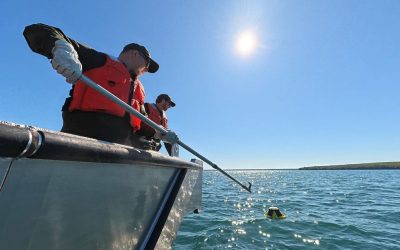
National Park Service boat operators on the bow of the Ajijaak – Jeff Rennicke photo
The arrival of the 28-foot Munson Packman Landing Craft signals the end of a multi-year process and the beginning of a new era for the National Park Service fleet in the Apostle Islands.

Garyck Hoenig, Supervisory Facility Operations Specialist
“It was a long process,” says Garyck Hoenig, Supervisory Facility Operations Specialist for the national lakeshore. Proposals were written in 2021 to secure the funding needed from the Midwest Regional office for the project, funding that was approved in 2022 kicking off more than 18 months of design work, construction, and sea trials at the Munson Shipyard in Burlington, Washington. “We needed a vessel capable of doing a lot of different things,” Hoenig says.
The Ajijaak (pronounced AH-jah-jok) will replace two former park vessels, the Raven and the Ziamo, and so had to be suitable for use in a variety of HSP (Historic Preservation) projects as well as Search & Rescue and general park duties.

Myron Basina, Marine Mechanic
“There was a lot of back and forth between the boat operators, a lot of different ideas and requirements that went into the final design to make it work for everything we are asking it to do,” says Myron Basina, the Park’s Marine Mechanic who also worked closely on the project. “And then every boat operator has their personality, little things they wanted to go into the design as well. In the end, I think we got a pretty good boat.”
That “pretty good boat” includes a number of important working features such as “Jack Plates” which can elevate the twin 250 horsepower Honda Outboards vertically allowing the vessel to operate in shallow water and maneuver safely when beaching, and a static hydraulic landing platform which, unlike the older pulley systems, offers consistent stability when loading and unloading materials or passengers even in rough wave conditions.

Tandem motors on Jack Plates – Jeff Rennicke photo

Tandem motors on Jack Plates – Jeff Rennicke photo
But perhaps the most unique design elements involve the accessibility features found on the new park vessel. An extra wide gunnel door or “dive door” on the starboard offers barrier-free access to the deck from a variety of docks at different water levels. The main cabin door is 10 inches wider than the standard door, allowing for easier access to the interior which features a wider cabin footprint and removable seats. “The extra room and the fact that the pedestal seats can be removed gives enough turning radius to maneuver for someone using a mobility device,” says Hoenig.

Dive door – Jeff Rennicke photo

Dive door and main cabin door – Jeff Rennicke photo

Dive door – Jeff Rennicke photo

Wide cabin door – Jeff Rennicke photo
That added accessibility and room on deck and in the cabin means safety and comfort not only for those with mobility challenges but allows search and rescue personnel the flexibility to position themselves in the safest location for rescue operations and even perform EMT functions inside of the cabin with victims strapped to a litter if required.
“The Ajijaak truly is a giant leap forward in the commitment to accessibility in the national lakeshore,” says Friends of the Apostle Islands Executive Director Jeff Rennicke. “Removing barriers for people of all abilities to access the lakeshore is one thing but making the commitment to having state-of-the-art capabilities to rescue everyone when and if they need it just adds another level of security for all visitors.”

Cultural Educator Payton Martinson\
That added security and comfort is also an important element for other kinds of trips as well. “The tribal elders will love this,” says Payton Martinson who works as a Cultural Educator helping to enhance public and staff understanding of Ojibwe culture, traditional knowledge, and Ojibwe perspectives into park operations. “We have a lot of elders who have lived their whole life in this area and rarely, if ever, get out to the islands,” Martinson says. “Getting them out there to share their wisdom and life experiences, especially with youth, is really important and the Ajijaak will make that even more possible.”
From cultural education and historic preservation projects to search and rescue and beyond, the Ajijaak is ready to take its place in the working fleet of Apostle Islands National Lakeshore, a place it will hopefully occupy for years to come. “A boat like this, if you take care of it properly, will last for decades,” says Garyk Hoenig. “Put it this way,” he says smiling, “The Ajijaak will likely be out there among the islands long after most of us are gone.”

National Park Service team members – Jeff Rennicke photo
Here’s to fair winds and smooth sailing for the Ajijak. Welcome to the Apostle Islands National Lakeshore.
You can learn more about the extensive training, teamwork and collabortion required to help keep boaters of all kinds safe in the Apostle Islands National Lakeshore in this companion report.
Share this article…
Bands of elk are not the only ones to gather in Estes Park, Colorado this autumn. The gateway city to Rocky Mountains...
We saw it in the first hints of crimson and gold in the mainland treeline. We felt it when the water temperature...

Far out on the blue horizons of Lake Superior, Whitney Martens got a surprise visit. Martens lives with Cerebral Palsy...