

The transformative power of nature: A new business member profile
Research has long shown that time spent in nature is good for us, body and soul. The American Heart Association, among...


We join the National Park Service and surrounding community members in celebrating the many contributions and the retirement of Apostle Islands National Lakeshore Superintendent Lynne Dominy of Bayfield. Prior to taking the leadership position in the Apostle Islands National Lakeshore in 2019, Dominy’s career included positions at Acadia National Park, Carlsbad Caverns National Park, Grand Canyon National Park, Point Reyes National Seashore, Bandelier National Monument and Little Bighorn Battlefield National Monument.
When Dominy arrived in 2019, she called working for the National Park Service a deep pleasure and immense responsibility. She said, “This National Lakeshore is forever linked to the cultures, lifestyles, and outdoor experiences of the Ojibwe people and other residents of Wisconsin and surrounding states. I am excited to learn from the park staff, listen to surrounding community ideas and needs, and experience every aspect of this wilderness and dynamic watershed.”
Now, after 38 years of service in the NPS and six years of service in northern Wisconsin, Dominy begins her next chapter. She sat down with Friends board member and former National Park Service Ranger Neil Howk for 10 questions about her accomplishments, memorable moments and her future.
Neil: Why did you apply for the superintendent’s job at Apostle Islands National Lakeshore?
Lynne: I think that I’d reached a point in my career when I was looking for something that would use the skills that I had acquired at all the different places that I had worked in the last 30 years combined with some new opportunities. So, when I applied here, I had never been on a Great Lake. I was intrigued with the idea of what I could learn about this ecosystem in contrast to oceans or deserts. I was also really interested in a park that had a lot of lighthouses, since I had the opportunity to be in Point Reyes and in Acadia working with lighthouses. So, I had a lot of experience with historic preservation and maritime history, and I was intrigued by the idea of lighthouses on a Great Lake.
One of the most meaningful parts of my NPS career has been working with tribal nations. Here, I was really excited to learn about treaty rights and tribal sovereignty. The fact that this park has two tribal nations on both boundaries made it even more interesting to me.

Red Cliff Band of Lake Superior Chippewa flag raising ceremony at Little Sand Bay in 2021 – Jeff Rennicke photo
I had been in parks with wilderness, so I was interested in managing wilderness on islands in this Great Lake environment, and in learning how it was different from being in the desert like at Bandelier (National Monument). I had also been in parks that were really, really crowded. So, it was nice to come to a place that is quiet and is very geographically spread out so you have to work hard to have experiences here, whether you are in a kayak or sailboat or any boat, because it takes a lot of effort to get anywhere. So, I was intrigued by a complex operation like Apostle Islands in a dynamic landscape like Lake Superior.
I also had never been to Wisconsin, and I only had Wisconsin and Michigan left on my list of states to visit. And of course I wanted to live in Bayfield. (laughter)
Neil: Ah yes, the best small town in the Midwest.
Lynne: I love that it doesn’t have a stop light. It’s still small enough that it is rural and quiet and its integrity is still intact.
Neil: So, what were some of your first impressions of the park?
Lynne: My first visit here was in February. So, I didn’t really get to go out into the park. I came in a snowstorm. I slid in a car down Washington Avenue (chuckle) because ice was really a problem. It was your classic winter (experience). But I was coming from Maine, so I wasn’t expecting a huge difference from being in Maine in terms of weather.
My first experience going out on the lake to the islands was in April. I really wanted to go and see the whole park to get a mental picture of how each of the islands was unique so I could begin to differentiate the responsibilities for managing each of them. I went with Dave Cooper, and he took me out to visit all the islands in about 18 hours in two days when we got the weather window. I needed to get a sense for how far it was between the islands, what the currents were like in the lake, the topography and the geography of the park… So, my first impression was “holy cow, it is pretty spread out here! (chuckle) And, wow, was it beautiful. It just takes a lot of effort to get to know it. So, I knew I was in for that kind of experience here, that it would take me many years before I could truly feel like I understood a lot of the dynamics that created these islands in this lake.

Lynne at mailbox – Jeff Rennicke photo
Neil: What was your favorite part about being the superintendent?
Lynne: Well, the favorite part of being the superintendent for me was building a team and building partnerships to help to support that team. And then building stronger relationships with the community. So, when I think about the job it was about doing those three things. Those three things are personally important to me. If you do a good job on all these relationships, then when you leave you know that you’ve made a difference. You’ve left stronger relationships and a stronger team. And you’ve made a lakeshore an extension of the community. Those things were really important to me.

Apostle Islands National Lakeshore team, June 2020
Neil: What was the most memorable thing you’ve seen in the Apostle Islands?
Lynne: There’s a lot of things. One of the most memorable… I haven’t been out on the lake very much at night. I find it very disorienting to travel by boat at night if there’s not very much light out on the lake. But one night we went out to Michigan Island to do a bat count. And there was a full moon. The whole way there the reflection of the moon on the lake, and the lake was just magically still, and you wonder, “is this really Lake Superior?” As we approached Michigan (Island) to have it be so still that there was a reflection of the moon and the lighthouse in the water, it just made a strong impression on me in terms of just the beauty and serenity of the place… part of the landscape that I hadn’t had a chance to experience… the amazing night skies. And just having the moon as your guide and being able to see everything around you in moonlight… that made a big impression on me. There are many stories but that is the one that stands out for me.
Neil: That is a good one. You’ve tackled a lot of projects in your time here. What would you say was the most challenging project that you had to deal with?
Lynne: I always make a joke that “this is my brain on docks.” (chuckle) Maintaining docks on Lake Superior is challenging. A lot of people don’t realize how much the ice impacts the shorelines, and how much water levels vary every year. Sometimes you get high water with a lot of shoreline and dock damage. Sometimes you get low water like we have this year, and everything is exposed out of the water and surrounded by sand. So, it is hard to manage the construction of and the care of 19 different docks on Lake Superior when conditions are constantly changing.
It is hard to get money for very expensive infrastructure. So, we worked for years just to get Sand Island (dock) repaired, and Manitou dock rehabbed, and Stockton Quarry Bay repaired, and to get funding for Outer Island dock to be fixed in a couple years, and right now for funding to repair the Little Sand Bay marina and Devils Island historic marina… It’s just constant project writing, presentations, talking about why it is so important to repair that infrastructure before it gets destroyed and you must rebuild from scratch. So, we’ve been trying to care for that infrastructure out there to continue to provide access for people because access to the islands is so important.

Dock work in progress on Sand Island in 2021 – NPS photo
Neil: Have you had any scary moments when you’ve been out in the park?
Lynne: I think probably one of the things that I would say was the scariest thing for me was when I began learning to operate boats on Lake Superior. You can never underestimate what this lake is going to dish out, and how quickly conditions can change. The constantly changing water levels, there different hazards, you must park the boat in different ways, the wind is always dynamic. So last year I decided I should go through the (boat operator) training process with the staff. Because we had a whole bunch of new staff, people were under a lot of stress learning in that environment. I thought, “huh, I need to have an appreciation for what it takes to be a boat captain.” How hard it is to read the wind; how important it is to pay attention to what everyone else is doing on the lake. And how the equipment behaves…all the different boats, the 15 boats we have, behave differently in this environment. And learn how you do landings at docks, on rock ledges, sometimes on beaches. It’s just a constantly dynamic environment where you are trying to master driving in that constant challenge. For me probably the scariest thing was not knowing how to do it. And not being mechanically minded. And needing to understand what everyone else was going through to operate boats safely on Lake Superior. To think more about how to focus on investing in boat safety on the lake.
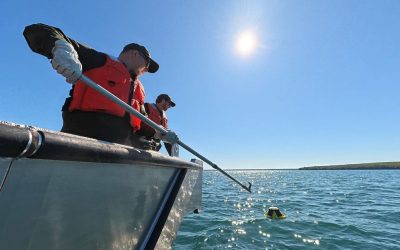
I think one of the great partnership projects that we worked on with the Friends is the (Wave Watch) weather buoys. These buoys have helped a lot of boaters on the lake understand varying conditions like water temperatures and wave heights and wind directions-all different depending on which side of which island you are located. Having awareness of that constantly changing dynamic and how you must adjust to it is key to safety on Lake Superior. I got more of an appreciation for this when I was learning to be a boat captain. And the times that I’ve been in a kayak is a whole other level of understanding about what the lake will dish out as the weather changes when you can’t get out and you’re not in a motorized boat.

Josh Anderson, Steve Ballou and Karl Carlson retrieve Wave Watch buoys – Jon Okerstrom photo

Wave Watch buoy with amber light lit – Jeff Rennicke photo
And then swimming in the lake…when you realize how strong the currents are, how fast the water is, and how quickly you lose muscle control in the extremely cold water. So, all these dynamics make boating on Lake Superior the scariest and most challenging thing that I have dealt with in my job. It is also something that I love about my job and why I always say that “the Lake is the Boss, not me.”
Neil: So, what would you say was the most enjoyable thing you’ve done during your time here as a superintendent?
Lynne: I’d say the most enjoyable thing I’ve done is to support the work of the staff when they are doing projects or planning for future operations. To see the projects they are doing when they are doing them on each island. To photograph their work to give them credit for the things they have accomplished. To see what it’s like to put a roof on the Devils Island fog building, which is a big task. This summer, what it is like to paint a big lighthouse like on Raspberry Island, which they’ll be working on. What it’s like to build boardwalks on a very wet island like Sand Island.

Reroofing the Devils Island fog station, July 2020 – NPS photo

Stockton Island amphitheater construction, May 2021 – NPS photo
How to protect endangered piping plover nests with exclosures. How to haze black bears so they learn to stay away from people and their food. So, it’s been important to go out and understand how people do their jobs on all the islands and then what things I can do to help them be successful. What training they need. What money we need to support that work happening. How we prioritize being able to have a historic preservation crew and trails crew every year when we have so many miles of trails, and so many miles of boardwalk, and we have so many different lighthouses. You know everything kind of gets in line and so it was a constant challenge, but also enjoyable to feel like I was a part of the important things that everyone was doing.

Piping plover in hand on Long Island – NPS photo

Lynne Dominy and Wisconsin Senator Tammy Baldwin on a boardwalk – Jeff Rennicke photo
Neil: What would you say was your most rewarding accomplishment in this job?
Lynne: I would say it was supporting the work of the team and helping develop the next generation of leaders. I was able to hire people that wanted to have a lifelong career working in the National Park Service. I focused on ways to help people learn, to develop skills in their jobs, and to continue to grow in their jobs. We had a lot of people retire in the last couple of years. So, we hired and trained new employees, and it was exciting to see their potential. I helped to design a dynamic work environment to inspire and motivate employees to do high quality work for the National Park Service.
In terms of accomplishments, I want to mention the Access for All campaign with the Friends. Working on accessibility is so important because it is an investment in everyone’s future. All of us have different physical needs during our lives- injuries, disabilities, and limitations in our life which require universally designed environments. When we design things universally, whether it’s the pathway at Meyer’s Beach that’s being done this summer or finishing the boardwalk on Sand Island to make one of our lighthouses fully accessible, or campsites…then we make those places and experiences open to everyone. Here we have invested in it together with partners and the community. We pay attention to it and make it a constant priority. I think the fact that we have worked hard to make this place as accessible as we can to as many different audiences and as many different experiences as possible is an important accomplishment. And that is something we must keep doing. I was glad that we worked with the Friends and a lot of other partners for the Access for All campaign to really raise the bar for what accessibility needs to look like on public lands. And we use it here to create an example for everybody about what is possible. It’s a good thing.

Lynne Dominy speaking at Stockton Island Amphitheater dedication – Jeff Rennicke photo

Lynne being interviewed about Meyers Beach Access For All project – Jeff Rennicke photo
Neil: If you were going to be marooned on one of the islands for a few days, where would you like to be and why?
Lynne: That’s a hard question. I guess I’ll say that I’ve been out on an island where I ended up staying longer than I thought I would stay because a storm came in. It’s a real interesting place to be…I was on Devils Island. When you have those big storms and you have those sea caves that are out there, it’s amazing to see the forces that create that type of erosion. To see the waves coming up on the shore. You get a better impression of what it was like to be a lighthouse keeper. What it’s like to be a mariner in a really big storm out on this lake. And the real importance of having things like lighthouses for navigation and islands for getting off the lake! And how fast it can happen, because in 20 minutes you can suddenly have something that gives you ten-foot waves which are a real different experience from only one-foot waves. But when you have this long fetch and these winds that come up so quickly and storms that build out over the lake that appear quickly with shearing winds and other things… it’s amazing how fast nature can work and how strong the forces of nature truly are.
Neil: So now that you are moving into your next chapter of life, what are you looking forward to doing now?
Lynne: My job was very demanding, so I was really focused on our team, so I had very little time or energy left to be a part of this community. Now I want to be very active in the nearby communities. I look forward to volunteering, finding ways to support local businesses, helping at the food banks and at the soup kitchen and at Encore (resale shop). Part of what I liked about my job was supporting the success of other people. So, if I can transition that into the community, I look forward to being able to do that.

Neil: And there you have ten questions with Lynne Dominy! Thanks for this, and everything you did for the park.
Neil Howk began working as a park ranger/interpreter for the National Park Service in 1978. He worked at a number of different parks over the years and served as the assistant chief of interpretation at Apostle Islands National Lakeshore from 1993-2016. He now serves as a board member of Friends of the Apostle Islands National Lakeshore.

Share this article…
Research has long shown that time spent in nature is good for us, body and soul. The American Heart Association, among...
Bands of elk are not the only ones to gather in Estes Park, Colorado this autumn. The gateway city to Rocky Mountains...
We saw it in the first hints of crimson and gold in the mainland treeline. We felt it when the water temperature...