

The transformative power of nature: A new business member profile
Research has long shown that time spent in nature is good for us, body and soul. The American Heart Association, among...


A growing number of power boaters, paddlers and sailors made smarter, safer choices thanks to Wave Watch buoys positioned in the Apostle Islands National Lakeshore during the 2025 boating season. The buoys provided real-time wave and water temperature information for five important locations in the Lakeshore. This week a team from the National Park Service and Friends of the Apostle Islands conducted the annual end-of-season buoy recovery mission, as Friends and our partners work on plans for 2026 and beyond.
The recovery team, led by Supervisory Park Ranger Karl Carlson boarded the 28-foot Ajijaak (“Sandhill Crane” in the native Ojibwe language) to make a hundred-mile trek around the National Lakeshore on a sunny September morning. Conditions for the mission were almost perfect, with nearly calm waters, mild temperatures and sunny skies with occasional fog.

Using specialized equipment and techniques developed by UW Research Scientist Josh Anderson, they collected solar-powered buoys and rigging from near the mainland sea caves, the north end of Devils Island, Red Cliff Point, the Stockton Island tombolo and a popular fishing area known as the Flats between Madeline and Long Islands. (Click each photo for a larger view.)

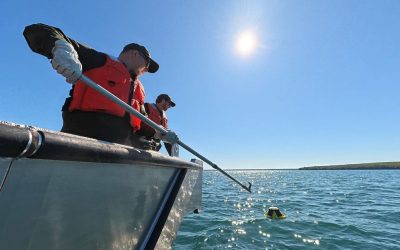
Approaching a Wave Watch buoy at the end of the 2025 season
The process involves snagging the yellow Wave Watch buoy with a boathook, bringing the yellow flag aboard, then attaching a red “lifter buoy” to the anchor line with a pulley assembly. Dropping the lifter buoy into the water then putting the boat into reverse forces the buoy to travel down the line and away from the boat. That action lifts the weights off of the lake bottom and attaches them under the buoy.

Jordan retrieves a yellow Wave Watch buoy with a boathook

Bringing the flag aboard
With the weights hanging directly beneath the buoy, the line can now be pulled back to the boat. It’s far easier than lifting the weights hand over hand off the lake bottom 60 to 100 feet below.
During this mission, unique gunnel door on the side of the Ajijaak (pronounced AH-jah-jok) made pulling the lifter buoy and heavy weights onto the deck much easier than it would be otherwise.

Assembling the hardware beneath the lifter buoy

Shane reverses the motors to force the lifter buoy to lift the weights off the bottom

Shane lifts the weights through the door

Assembling the stainless steel pins and pulley

Karl pulls in the lifter buoy and weights

Coiling the rigging into a trash can to keep the deck organized
The flags marking the buoy locations took a beating during the season but overall, the system worked wonderfully, sending wave height, direction and surface temperature data to a satellite 24 hours a day, 7 days a week. After processing at the University of Wisconsin, the data is published on the real-time data page on the Friends website, as well as on the original WISC-Watch website from the University of Wisconsin.

A full summer on the water takes its toll on the flags
The two websites recorded a combined 33,000 visits during the 2025 boating season, a significant increase from 2024. As you might expect, the days when the biggest waves and most-dangerous conditions were being reported generated the most interest.
Friends Executive Director Jeff Rennicke says the growing metrics and comments from boaters confirm the value of the Wave Watch project. He says, “Safety must be the top priority on Lake Superior. The Wave Watch network makes it much easier to decide when it’s safe to go out and when it’s better to stay home. We’re pleased that so many people used the service to make smart decisions.”
Wave Watch is a partnership involving the University of Wisconsin – Madison, the National Park Service which supplies in-kind support and Frinds of the Apostle Islands, which provides funding for ongoing expenses.

During the off-season, we’ll be working on plans for 2026. The Friends Board of Directors has approved working to continue the partnership, which also enjoys ongoing support from the National Park Service and from our partners at the University of Wisconsin. Rennicke says, “It’s been another great year. We are optimistic about continuing the program in 2026 and beyond.”
Your safety on the water is always a priority in the Apostle Islands National Lakeshore. In the weeks ahead, we will have much more to say about the future of this vital boater safety program and how you can help.

Seagull takes a last break on a Wave Watch buoy


Written and photographed by Jon Okerstrom, a Friends of the Apostle Islands National Lakeshore board member and digital and social media volunteer with a background in digital and television journalism, photography and graphic design.
Share this article…
Research has long shown that time spent in nature is good for us, body and soul. The American Heart Association, among...

Bands of elk are not the only ones to gather in Estes Park, Colorado this autumn. The gateway city to Rocky Mountains...
We saw it in the first hints of crimson and gold in the mainland treeline. We felt it when the water temperature...